Still running your business through WhatsApp groups and spreadsheets? A website tells the world you exist - but a custom web app actually runs your business. Discover why companies in the US, UK, and Canada are making the switch in 2026, and how the ROI often pays off within the first year.
Still running your business through WhatsApp groups and spreadsheets? A website tells the world you exist. A custom web app actually runs your business. Here is why companies in the US, UK, and Canada are making the switch in 2026, and how the investment often pays for itself within the first year.
Website vs web app: what is the actual difference?
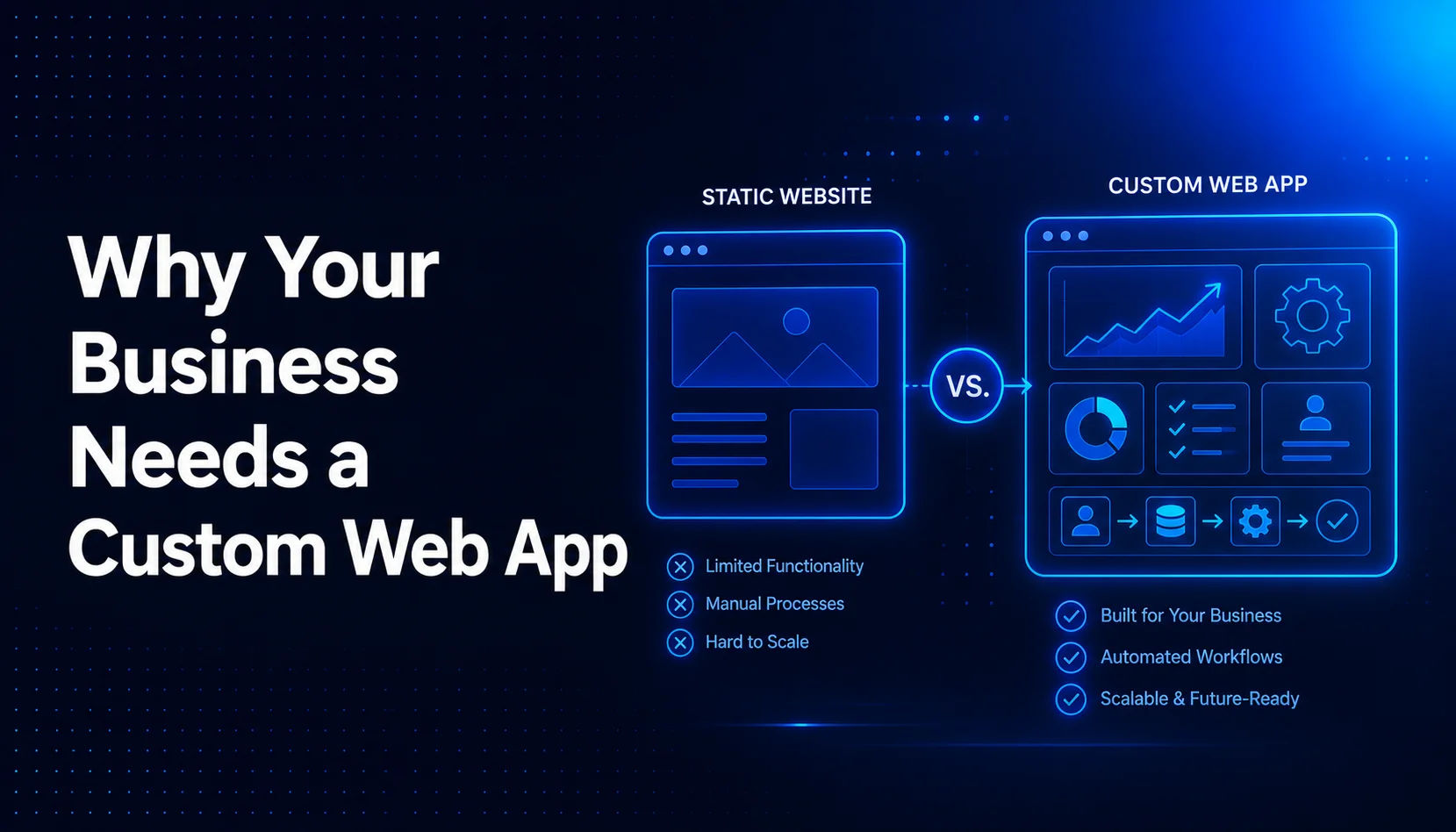
A website is mostly passive. It shows information: who you are, what you offer, how to contact you. That is valuable, but it does not do anything.
A custom web app is active. It runs a process: bookings, orders, dashboards, approvals, customer accounts. Instead of just describing your business, it operates part of it. That is the leap, from a brochure to a tool your business actually runs on.
The real cost of patching things together
Most growing businesses do not decide to stay on spreadsheets. It happens gradually. A spreadsheet here, a WhatsApp group there, three different SaaS tools that do not talk to each other, and a lot of manual copying in between.
Each piece seems fine on its own, but together they create real cost: wasted hours, duplicated data, mistakes, and no single source of truth. You are paying for that mess every month, just not on one invoice.
What a custom web app actually does for your business
A custom app is built around exactly how you work, so it can:
Automate repetitive tasks that currently eat your team's time.
Centralize your data in one place instead of scattered across tools.
Scale with you, adding features as your business grows.
Give you real-time visibility into what is happening, right now.
Because it is built for your workflow specifically, there is nothing to work around. The software fits the business, not the other way around.
What this looks like in practice
A couple of real-world patterns show the impact:
A clinic replaces phone-and-paper booking with a custom scheduling app and cuts no-shows dramatically with automated reminders.
A courier company replaces "where is my order" phone calls with a live tracking portal, freeing up staff and improving customer trust.
In both cases the app did not just look nicer. It removed a recurring, expensive problem.
Is it expensive? An honest answer
There is an upfront cost, and I will not pretend otherwise. But in higher-wage markets especially, a custom app that saves your team hours every week often pays for itself within the first year, and keeps paying after that. If you want the full breakdown, I have written about [what it costs to turn a spreadsheet into a web app](https://osamahabib.com/blog/cost-to-turn-spreadsheet-into-web-app) and [WordPress versus a custom web app](https://osamahabib.com/blog/wordpress-vs-custom-web-app) to help you decide what fits.
Is a custom web app right for you right now?
You are probably ready if you recognize these signs:
Your business runs on WhatsApp and spreadsheets.
You use several tools that do not connect to each other.
Manual processes are slowing your growth or causing errors.
If none of that sounds like you, a good website may be all you need for now. If it does sound like you, the mess is only going to get more expensive. These are the same signals I cover in [5 signs your business has outgrown its website](https://osamahabib.com/blog/signs-your-business-has-outgrown-its-website).
The bottom line
A website says you exist. A custom web app runs your business. As your operations get more complex, the difference between the two stops being a nice-to-have and becomes the thing holding you back or pushing you forward.
Frequently asked questions
What is the difference between a website and a web app?
A website mainly presents information, while a web app performs actions and runs processes like bookings, orders, dashboards, and accounts. A website describes your business; a web app operates part of it.
Is a custom web app worth the cost for a small business?
Often yes, if you are losing hours to manual work or juggling disconnected tools. A custom app that saves your team time every week frequently pays for itself within the first year, especially in higher-wage markets.
When should a business move from spreadsheets to a custom app?
When spreadsheets and chat apps become the system your business runs on, and errors, duplication, or manual work start slowing your growth. That is the point where a custom app saves more than it costs.
Do I need a custom web app or just a website?
If your needs are mostly informational, a website is enough. If you need to run workflows, manage data, or automate operations unique to your business, a custom web app is the better fit.
If your business is at that point, or getting close, I would be happy to talk through what the right solution looks like for you specifically. Tell me how your business currently runs (https://osamahabib.com/contact) and I will give you an honest recommendation.
Osama Habib
Multan, Pakistan
Full Stack Developer specialising in Next.js, Node.js, and the MERN stack. I write about modern web development, system design, and practical engineering.