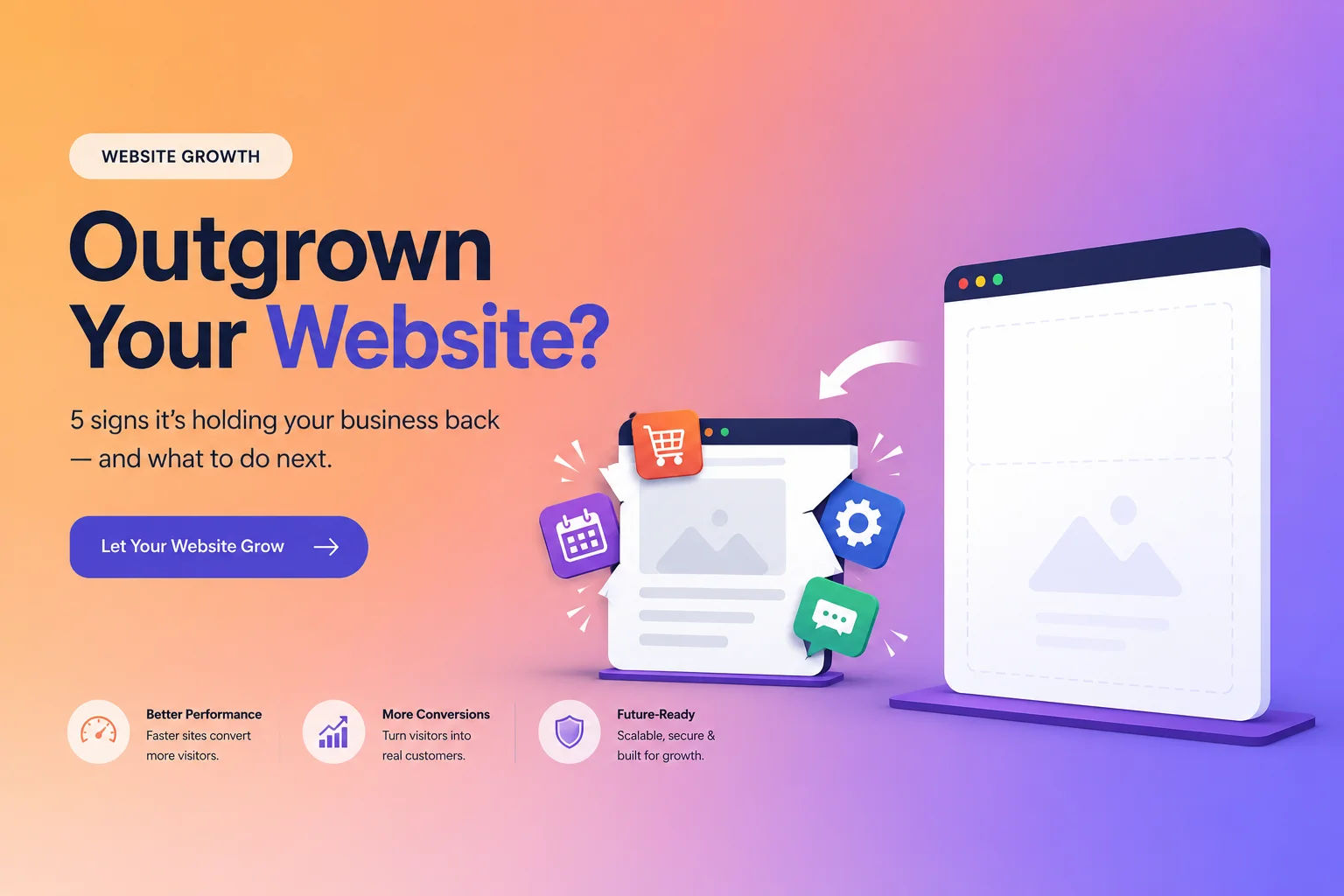
Your website was fine when you launched - but is it holding your business back now? Here are 5 clear signs you've outgrown it, and how to decide between a redesign and a custom rebuild.
When you first launched your website, it did the job: a homepage, an about page, a contact form. But businesses grow, and websites don't automatically grow with them. At some point, the site that once helped you starts quietly holding you back - costing you inquiries, credibility, and hours of frustration you can't quite explain.
The tricky part is that outgrowing a website is gradual. There's rarely one dramatic moment. So here are five clear signs your business has outgrown its website, and a straight answer on what to do about each one.
1. It's slow - and slow is costing you customers
Websites get slower as they age. Plugins pile up, images go uncompressed, and quick fixes get layered on top of older quick fixes until the whole thing loads a beat slower every quarter. This isn't cosmetic: a 1-second delay in load time can cut conversions by up to 7%, and visitors routinely abandon sites that take more than 2–3 seconds to appear.
If your site feels sluggish, you're not just annoying visitors - you're losing them before they ever see your offer.
2. You need a developer for every small change
When you launched, simple edits were easy. Now, changing a price, adding a page, or updating a service means emailing someone and waiting. If your site has become so fragile or so technical that routine updates require a developer every time, the platform it's built on is working against you, not for you.
A modern site should let your team make everyday changes without fear of breaking something.
3. You've outgrown a "brochure" site - you need it to do things
This is the biggest one. When you started, you needed a contact form. Now you need online booking, payments, a client portal, gated content, or an integration with your CRM or inventory system. Your business runs on workflows your website can't handle, so you're patching the gaps with spreadsheets, manual emails, and third-party tools that don't talk to each other.
That's the clearest sign you've outgrown a template website. You don't need a prettier brochure - you need your website to actually run part of your business.
4. It looks dated next to your competitors
First impressions are overwhelmingly visual - research suggests 94% of first impressions of a website are design-driven, and a large share of visitors judge a company's credibility on design alone. If your site looks boxy or five years behind while your competitors look clean and modern, visitors quietly assume your business is behind too - even if you're the better choice.
5. Traffic comes in, but inquiries don't
If people are visiting but not booking, buying, or reaching out, something between interest and action is broken. It could be unclear messaging, weak calls to action, a confusing layout, or too many steps to get in touch. A website's job isn't to look nice - it's to turn visitors into customers. When it stops doing that, it's no longer pulling its weight.
What to do next: redesign or rebuild?
Not every sign means starting over. Here's how to decide:
If it's mainly about looks and messaging, a redesign on your current platform may be enough.
If it's slow, fragile, and can't do what your business now needs - booking, payments, portals, integrations - you've likely outgrown the platform itself, and a custom rebuild will serve you far better than another round of patches.
The honest test: are you fighting your website to do normal things? If yes, patching it again will only buy you a few more months. Building something that fits how your business actually works is what finally solves it.
Frequently asked questions
How do I know if I need a redesign or a completely new website?
If the problem is mostly visual or content-related, a redesign may do. If your site is slow, breaks often, or can't support the features your business now needs, you've likely outgrown the platform and need a rebuild.
How often should a business update its website?
Most businesses benefit from a meaningful refresh every 2–3 years, but the real trigger is need, not age - if your site can't keep up with how your business operates, it's time regardless of the calendar.
My website is slow - is that reason enough to rebuild?
Speed alone can often be improved without a full rebuild. But if slowness comes alongside fragility and missing functionality, it's usually a symptom of an aging platform that's worth replacing.
Do I need a custom website or is a template enough?
Templates are fine for simple, content-focused sites. Once you need custom workflows, integrations, or features unique to your business, a custom build saves you from endlessly working around a template's limits.
If several of these signs sound familiar, your website has probably outgrown its platform - and I can help. I build fast, modern websites and custom web apps designed around how your business actually works. Tell me what's frustrating you (https://osamahabib.com/contact) and I'll tell you honestly whether you need a redesign or a rebuild.
Osama Habib
Multan, Pakistan
Full Stack Developer specialising in Next.js, Node.js, and the MERN stack. I write about modern web development, system design, and practical engineering.