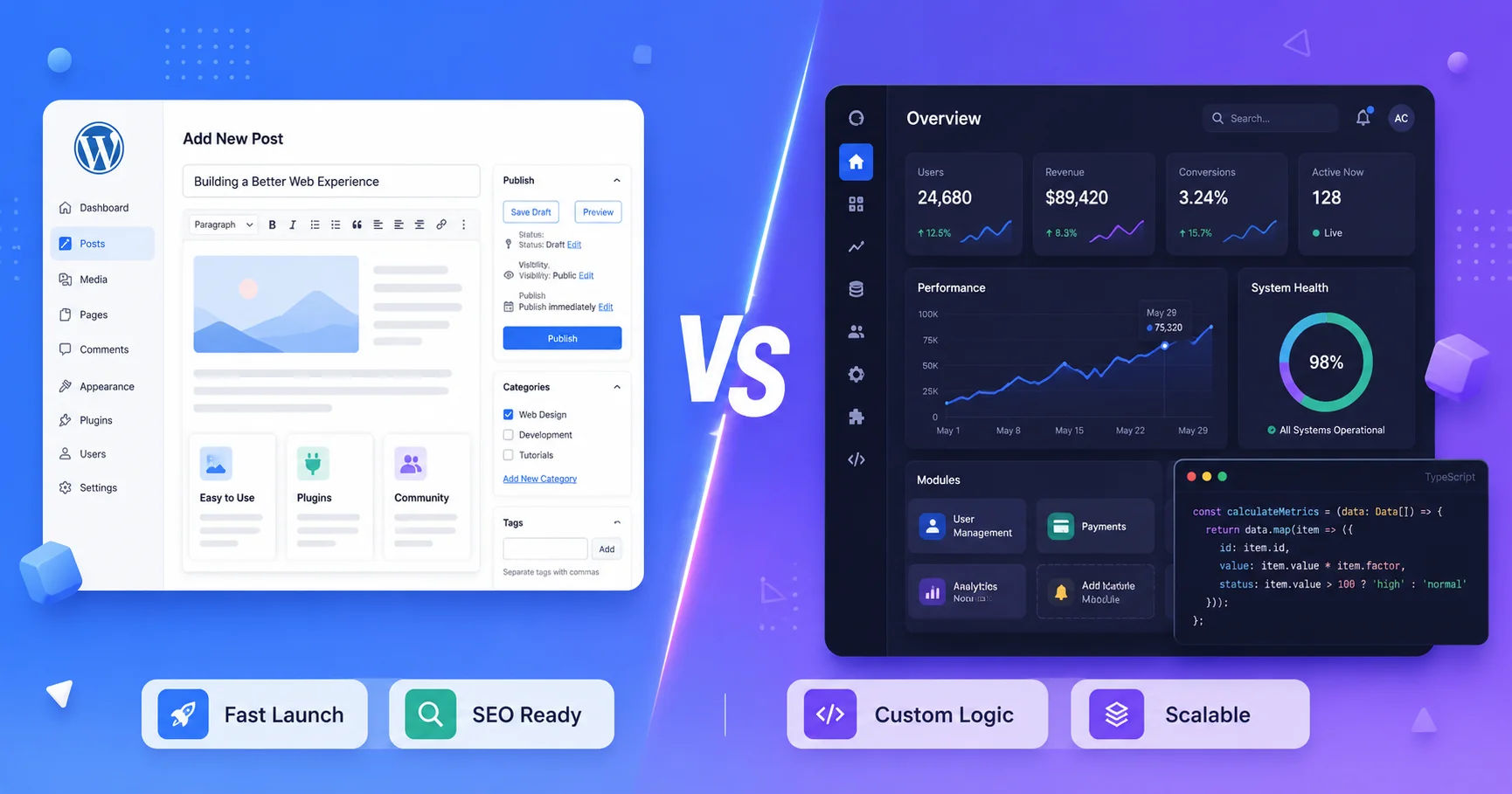
A developer's honest take on WordPress vs a custom web app - when WordPress is genuinely the smarter choice, when it quietly holds you back, and how to decide for your business.
Here's something you don't often hear from a custom web developer: most businesses should just use WordPress. It's fast to launch, affordable, and genuinely good at what it was built for. So before you spend money on custom development, it's worth knowing exactly when it's the right call - and when it's an expensive mistake in either direction.
I build custom web apps for a living, but I'd rather tell you the truth than sell you something you don't need. So here's an honest breakdown of WordPress vs a custom web app in 2026, and a simple way to decide which one your business actually needs.
When WordPress is the smarter choice
WordPress powers a huge share of the web for good reasons. Choose it when:
Your site is mostly content. Blogs, marketing sites, news, and SEO-driven content are exactly what WordPress was built for.
Your budget is modest. A well-built WordPress site often starts at a fraction of custom development. Under roughly $10,000 with standard needs, WordPress is usually the financially smart move.
A non-technical person will update it. WordPress gives your team a familiar dashboard to edit pages and posts without touching code.
You need to launch quickly. WordPress (with WooCommerce for stores) can get you live in weeks rather than months.
If that describes you, don't overthink it. WordPress is the right tool, and a custom build would be money poorly spent.
When a custom web app is worth it
Custom development earns its higher upfront cost when your business needs something WordPress wasn't designed to do:
Unique workflows. Multi-step approvals, custom pricing rules, role-based processes specific to how you operate. In WordPress you'd end up bolting these on with plugins until you've basically built a fragile custom app anyway - with all of WordPress's overhead still attached.
Complex or real-time features. SaaS tools, dashboards, booking systems, live data. WordPress is a content manager; bending it into an application platform creates technical debt.
Performance that converts. A well-built Next.js app routinely hits 95–100 PageSpeed scores because it loads zero unnecessary code. That matters: every 1-second improvement in load time can lift conversions by 7–12%.
Security and ownership. Most WordPress vulnerabilities come from third-party plugins and themes maintained by strangers. Custom code removes that attack surface, and you own everything - no annual license fees for features core to your business.
Long-term scale. If you're planning sustained growth, custom is built specifically to expand. For complex needs, it often becomes cost-neutral within 2–3 years while giving you far more flexibility.
The honest middle ground: a hybrid approach
You don't always have to choose. Many smart businesses start on WordPress for speed and budget, then build a custom web app for the one or two workflows that actually differentiate them as they grow. Your marketing site stays on WordPress; your product or internal tool becomes custom. Best of both worlds.
A 30-second decision framework
Ask yourself one question: is the thing you're building mostly about publishing content, or mostly about doing something?
Mostly publishing content (pages, posts, products) → WordPress.
Mostly doing something (workflows, logic, real-time, accounts, automation) → custom web app.
A bit of both → WordPress for the site, custom for the app, connected together.
Frequently asked questions
Is a custom web app always better than WordPress?
No. For content-driven sites with standard needs and a modest budget, WordPress is usually the better and cheaper choice. Custom is better only when your needs outgrow what WordPress was built for.
Is WordPress bad for SEO compared to custom?
Not inherently - WordPress can be excellent for SEO. Custom builds can edge ahead on raw speed and Core Web Vitals, but a well-optimized WordPress site competes well on content-driven SEO.
Can I start on WordPress and switch to custom later?
Yes, and many businesses do exactly that. A common path is launching on WordPress, then building custom for specific workflows once the business and its requirements are clearer.
Is a custom web app more expensive than WordPress?
Upfront, yes. But for complex requirements it often becomes cost-neutral within 2–3 years thanks to no license fees, better performance, and not fighting the platform.
Not sure which side of the line your business falls on? I help business owners make this exact decision honestly - and only build custom when it genuinely pays off. Tell me what you're trying to do (https://osamahabib.com/contact) and I'll give you a straight recommendation.
Osama Habib
Multan, Pakistan
Full Stack Developer specialising in Next.js, Node.js, and the MERN stack. I write about modern web development, system design, and practical engineering.