A developer's honest 2026 breakdown of how long it really takes to build a custom web app - realistic timelines by complexity, what speeds it up, and what quietly slows it down.
"How long will it take?" is usually the second question a founder asks me, right after "how much will it cost?" And like cost, the honest answer is a range, but a range I can make useful once you understand what actually drives it.
Most articles on this topic are written by agencies, and they tend to nudge every answer toward a big, long, expensive project. I build web apps as an independent developer, so here is the straight version: how long a custom web app really takes in 2026, broken down by complexity and by phase, with the factors that speed it up or quietly drag it out.
The short answer
Most custom web apps take between 6 weeks and 6 months. A focused MVP lands around 6 to 12 weeks. A full, multi-feature product is usually 3 to 6 months. Anything past that is either genuinely complex or suffering from unclear scope, and the second one is far more common than people admit.
Timeline by complexity
Simple app: roughly 4 to 8 weeks
One core workflow, authentication, a clean dashboard, maybe payments. Think an internal tool, a booking system, or a niche CRM. One experienced developer can ship this in a month or two.
Standard app: roughly 3 to 4 months
Multiple user roles, a polished UI, several integrations (email, payments, third-party APIs), and some automation. This is where most funded products and serious internal platforms land.
Complex platform: 6 to 12 months
Multi-tenancy, real-time features, heavy data processing, AI features, or strict compliance. Timelines here grow with complexity and team size, not just feature count.
Where the time actually goes (phase by phase)
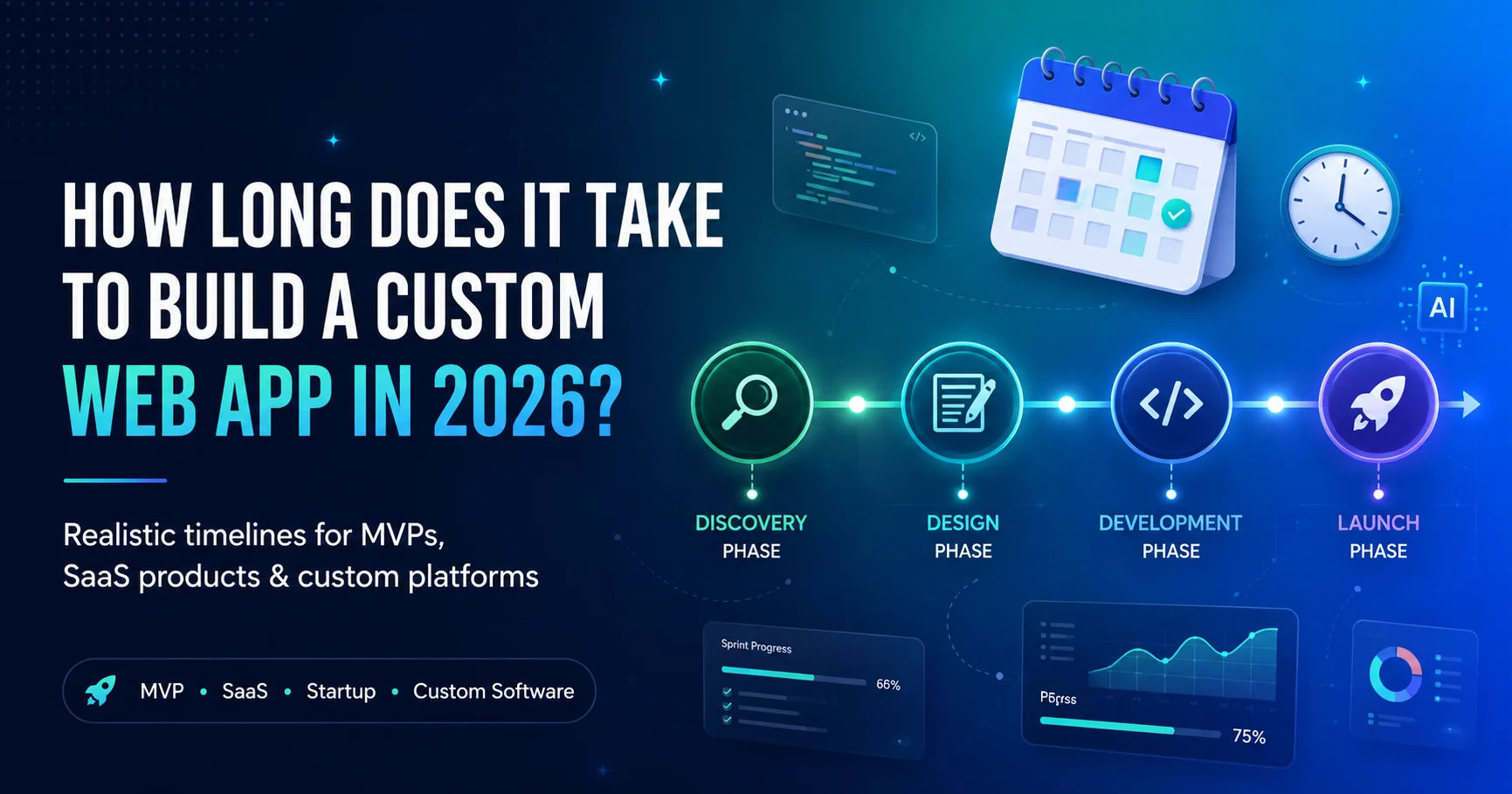
A common misconception is that "building" means writing code. In reality, a healthy project splits across four phases:
Phase | What happens here | Typical share of the timeline |
Discovery and planning | Understanding the real workflow, edge cases, and what not to build | 10 to 20% |
Design | Turning the workflow into screens and user flows | 15 to 20% |
Development | The actual building of frontend, backend, and database | 45 to 55% |
Testing and launch | Real-world testing, fixes, and safe deployment | 15 to 20% |
Skipping discovery to "save time" is the single most expensive shortcut I see. Two weeks of clarity up front saves months of rebuilding later. If you want a sense of how these phases map to budget as well as time, I break that down in my guide on [how much it costs to build a SaaS MVP](https://osamahabib.com/blog/how-much-does-it-cost-to-build-a-saas-mvp-2026).
What speeds it up
Several things reliably shorten a build:
A clear, narrow scope. The fastest projects ruthlessly cut everything non-essential from version one.
An experienced developer who has built similar systems before, so there is no learning on your dime.
Modern tooling. A stack like Next.js with Prisma and PostgreSQL lets one developer move fast without a big team.
AI-assisted development. In 2026, AI coding tools have genuinely compressed build time by around 30 to 50% for routine work. They speed up the typing, not the thinking, so discovery and architecture still take human judgment.
What quietly slows it down
Unclear or changing requirements. "Can we also add..." mid-build is the number one timeline killer.
Too many features in version one. Every extra role, integration, and screen compounds.
Slow feedback. If approvals take a week each, the calendar stretches even when the work does not.
Rushing. Ironically, demanding an unrealistic deadline usually adds 15 to 30% in cost and rework.
How to get yours built faster (without cutting corners)
Decide on the one workflow that proves your idea and build only that first. Ship it, get real users on it, and let their feedback direct version two. This is not just cheaper, it is faster to something real and usable, which is the only deadline that actually matters. This is exactly how I approach [custom web app development](https://osamahabib.com/services/custom-web-apps) for the founders I work with.
Frequently asked questions
How long does it take to build an MVP specifically?
A focused MVP typically takes 6 to 12 weeks with one experienced developer. The biggest variable is how tightly you scope it.
Can a web app be built in under a month?
Yes, if it is a single, simple workflow with authentication. Anything with multiple roles or integrations realistically needs more than four weeks to do well.
Does using AI tools make development faster?
In 2026, yes. AI tools meaningfully speed up routine coding, often by 30 to 50%. But they do not replace the planning and architecture decisions, which are where projects are really won or lost.
Why do agencies quote longer timelines than freelancers?
Larger teams carry more coordination overhead and process. An experienced independent developer can often move faster on small to medium projects with less back and forth.
What takes the most time when building a web app?
Development is the largest single phase, but discovery and planning have the biggest impact on the total. Time spent understanding the workflow up front prevents expensive rework later.
Trying to plan a realistic timeline for your specific idea? I help founders turn an idea into a working web app without the agency overhead or the inflated schedule. Tell me what you are building (https://osamahabib.com/contact) and I will give you an honest timeline and a plan to hit it.
Osama Habib
Multan, Pakistan
Full Stack Developer specialising in Next.js, Node.js, and the MERN stack. I write about modern web development, system design, and practical engineering.