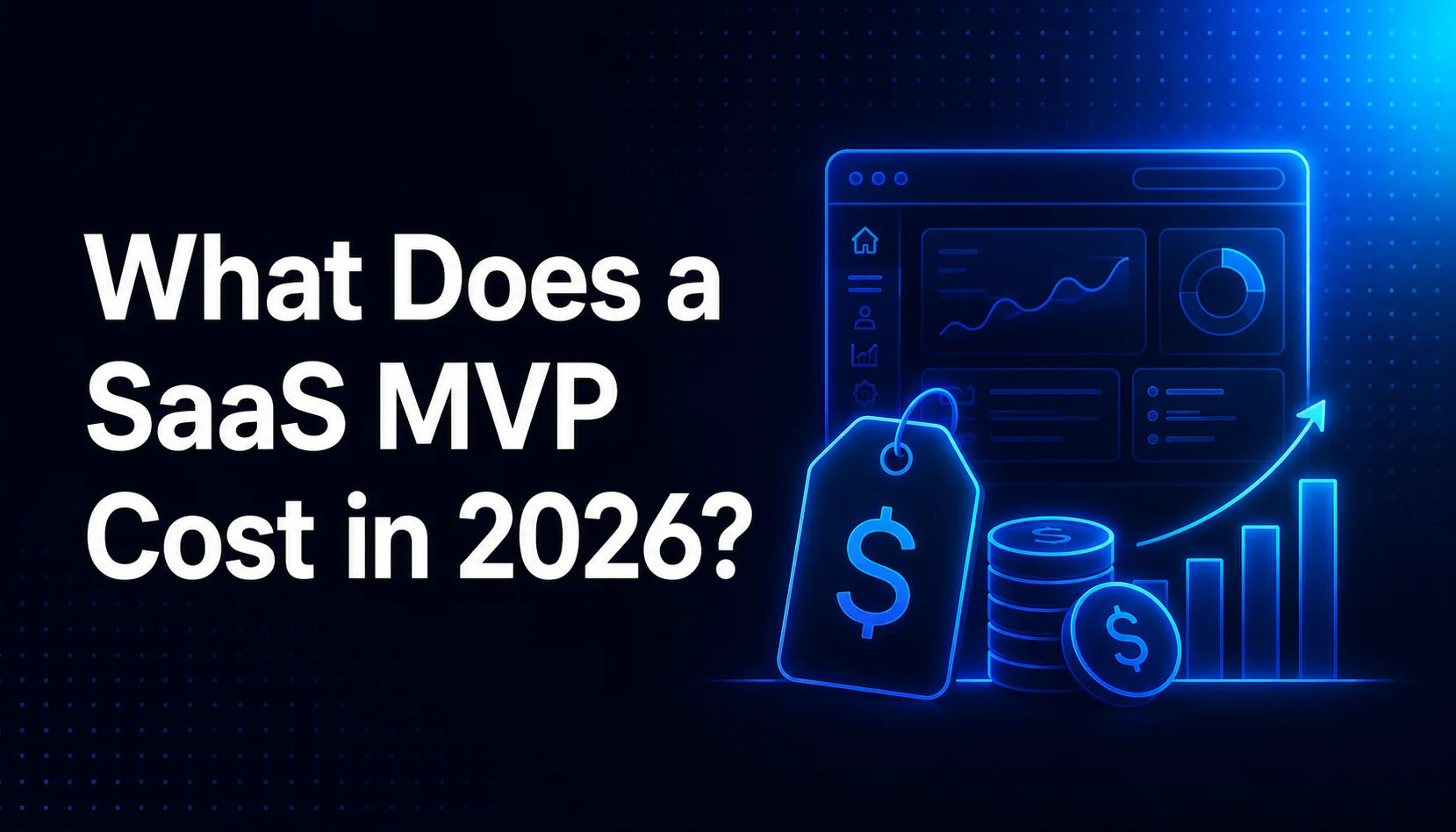
A no-fluff, developer's breakdown of real SaaS MVP costs in 2026 - the price ranges, what actually drives them up, and where founders quietly waste money.
"How much will it cost to build my SaaS?" is the first question almost every founder asks me - and it's also the hardest one to answer in a single number. The honest truth is that a SaaS MVP can cost anywhere from a few thousand dollars to well over fifty thousand, and the difference usually isn't the code. It's the decisions you make before a single line is written.
I build SaaS products for a living, so instead of a vague "it depends," I'll give you real 2026 price ranges, a clear cost-breakdown table, a worked example, and the ongoing costs most guides conveniently forget. By the end you'll be able to estimate your own MVP within a sensible range.
First, what an MVP actually is (and isn't)
An MVP - minimum viable product - is the smallest version of your idea that a real user would pay for or rely on. It is not a stripped-down toy, and it's not the full product you imagine launching in two years. It's the core loop: the one workflow that delivers your main promise.
The biggest cost mistake happens here, before development even starts. Founders describe an MVP but actually specify a v3. Every "small" extra feature - a second user role, a referral system, an admin analytics dashboard - adds real hours. Scope is the single biggest lever on price.
SaaS MVP cost ranges in 2026 (at a glance)
Here's how the market actually breaks down for Next.js / MERN-stack SaaS builds:
MVP type | Typical cost | What it includes | Timeline |
Lean MVP | $3,000 – $8,000 | One core workflow, authentication, a clean dashboard, Stripe subscription billing, a database | 3–6 weeks |
Standard MVP | $8,000 – $20,000 | Multiple user roles, polished UI, integrations (email, payments, APIs), some automation, proper deployment | 6–12 weeks |
Complex MVP | $20,000+ | Multi-tenancy, real-time features, heavy data processing, AI features, or compliance requirements | 3–6 months |
Most early founders should be aiming at the lean or standard tier. The complex tier is for products that are genuinely complex - not for a first version that could have been simpler.
The three tiers explained
1. Lean MVP - $3,000 to $8,000
One core workflow done well: sign-in, a clean dashboard, billing, and a database. Think a booking tool, a niche CRM, or a simple analytics dashboard. One experienced full-stack developer can ship this in a few weeks. If you're testing a brand-new idea, start here.
2. Standard MVP - $8,000 to $20,000
The sweet spot for a fundable SaaS. Multiple roles, a polished interface, real integrations, and some automation - enough to impress early users and investors without over-building.
3. Complex MVP - $20,000 and up
Multi-tenancy, real-time data, AI, or compliance (think healthcare or fintech). Cost climbs with genuine complexity and the number of people involved, not just feature count.
A worked example
Say you're building a subscription-based booking SaaS - customers book appointments, providers manage availability, and you take a monthly fee. Realistically:
Authentication and accounts: foundation, modest.
The booking workflow with availability and conflict handling: this is the core value, where most of the budget goes.
Stripe subscription billing: a defined, well-understood piece.
A clean dashboard for both sides.
That lands around $6,000–10,000 as a focused MVP - a lean-to-standard build. Add a second business type, an admin analytics suite, and a mobile app, and you've quietly turned an $8k MVP into a $25k project. Same idea, very different cost - because of scope, not code.
What actually drives the price up
Number of user roles. One role is simple. Admin + customer + team-member triples the permission logic, the UI states, and the testing.
Integrations. Stripe, email, calendars, AI APIs, webhooks - each is reliable but adds real engineering and edge-case handling.
Custom design vs a clean system. A polished, sensible UI is affordable. Pixel-perfect custom design with animations is a separate budget.
Who builds it. An agency carries overhead, so the same MVP often costs 2–3x more than with an experienced independent developer - without being 2–3x better.
The costs most guides forget: ongoing expenses
The build price isn't the whole picture. Budget for these too:
Hosting and infrastructure: often modest early on (a database, hosting, email) - think tens of dollars a month at first, scaling with usage.
Third-party services: Stripe fees, email providers, any paid APIs.
Maintenance and iteration: plan for roughly 15–20% of the build cost per year for fixes, updates, and small improvements once you have real users.
Factoring these in from the start keeps you from being surprised three months after launch.
Where founders waste money
Building features no one asked for yet. That settings page with twelve toggles can wait until users request it.
Over-designing before product-market fit. Spend on the workflow, not on a landing page you'll throw away in three months.
Choosing the wrong builder for the stage. A huge agency for a $6k MVP is overkill; a $5/hour freelancer who disappears mid-project costs far more in rework.
How to get a better MVP for less
You don't lower cost by cutting quality - you lower it by cutting scope intelligently. Pick the single workflow that proves your idea, ship that, get real users on it, and let their feedback fund and direct version two. A modern stack like Next.js with Prisma and PostgreSQL lets a single developer move fast and keep the codebase clean enough to scale later, which is exactly what you want at the MVP stage.
Frequently asked questions
How much does it cost to build a SaaS MVP in 2026?
Most SaaS MVPs fall between $3,000 and $20,000: roughly $3,000-8,000 for a lean single-workflow MVP, $8,000-20,000 for a standard multi-role product, and $20,000+ for complex builds with multi-tenancy, AI, or compliance.
How long does it take to build a SaaS MVP?
A lean MVP typically takes 3-6 weeks with one experienced developer; a standard MVP 6-12 weeks. Complexity and how quickly you make decisions affect this more than anything.
What are the ongoing costs after building an MVP?
Expect hosting and third-party service fees (often modest at first) plus roughly 15–20% of the build cost per year for maintenance, updates, and improvements once you have real users.
Is it cheaper to hire a freelancer or an agency for an MVP?
For most early-stage MVPs, an experienced independent full-stack developer gives the best cost-to-quality ratio - often 2–3x cheaper than an agency for a comparable result. Agencies make sense once you need a larger team and ongoing scale.
Can I build a SaaS MVP for under $5,000?
Yes, if you keep the scope to one genuine core workflow with authentication and billing. The trick is ruthless prioritization, not cheap code.
What stack is best for a SaaS MVP in 2026?
Next.js with a typed backend, Prisma, and PostgreSQL is a reliable, fast, and scalable default - it lets you start lean and grow without a rewrite.
Thinking about building your SaaS? I help founders turn an idea into a clean, launch-ready MVP without the agency price tag. Tell me what you're building (https://osamahabib.com/contact) and let's scope it out together - I'll give you an honest range.
Osama Habib
Multan, Pakistan
Full Stack Developer specialising in Next.js, Node.js, and the MERN stack. I write about modern web development, system design, and practical engineering.