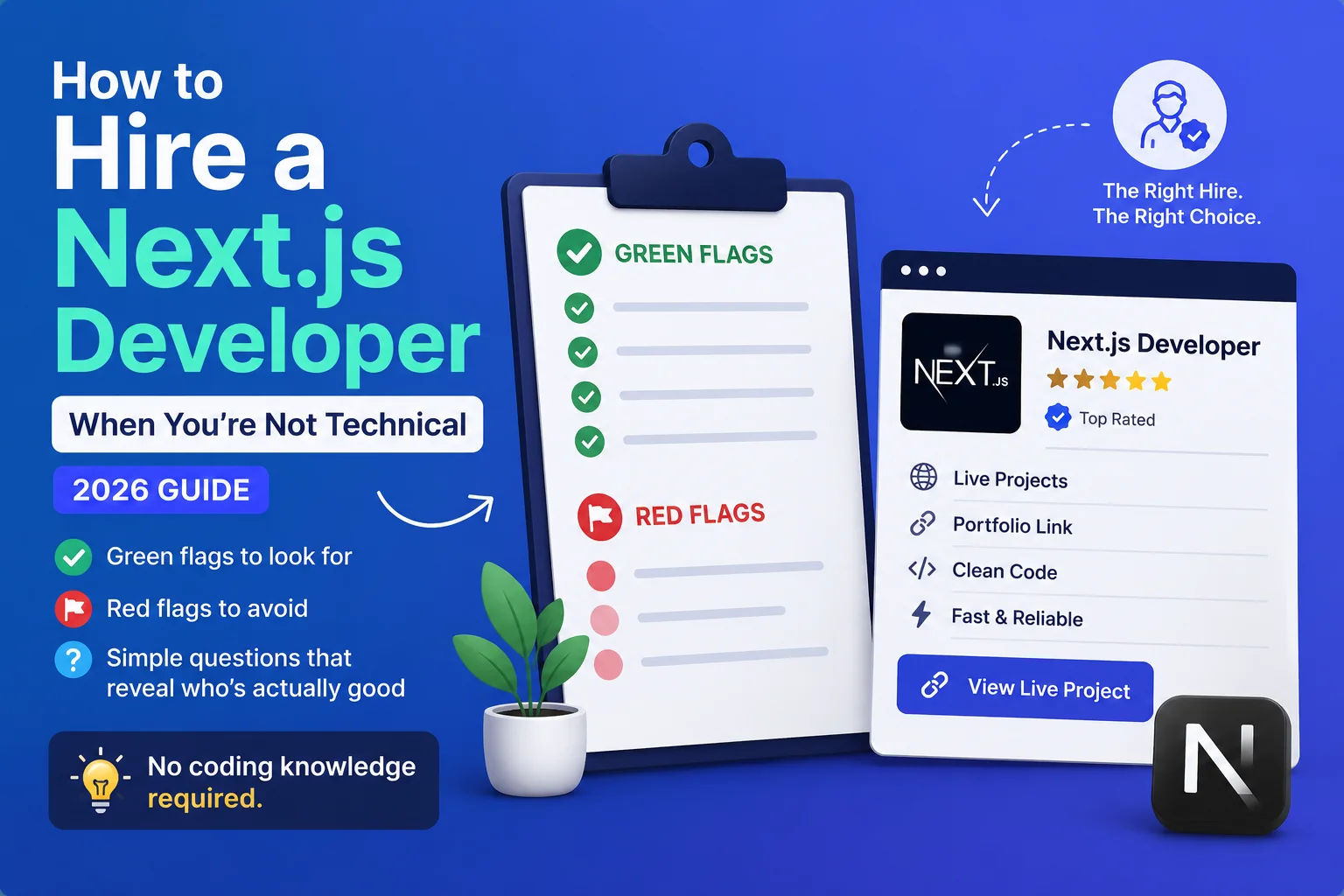
You don't need to be technical to hire a great Next.js developer. Here are the green flags, the red flags, and the simple questions that tell you who's actually good - no coding knowledge required.
Hiring a developer is nerve-wracking when you can't read code. How do you tell a genuinely good Next.js developer from someone who just talks a good game? Most guides on this topic are written for technical hiring managers and are full of interview questions you couldn't judge the answers to anyway.
This one is different. I'm going to show you how to hire a great Next.js developer without being technical yourself - the green flags to look for, the red flags to walk away from, and a few simple questions where even the answer tells you what you need to know.
First: what a Next.js developer should actually do for you
You don't need the jargon, but it helps to know what the role covers. A strong Next.js developer can usually handle your whole web product end to end: the part users see (the interface), the part that runs behind it (the logic and database), user accounts and logins, payments, and getting it live and fast. In plain terms - one capable person can often build the whole thing, not just the pretty front page.
If someone can only do the visual layer and needs you to find "a backend person" separately, that's fine for simple sites, but it means more coordination and cost for anything real.
The green flags - signs someone is the real deal
- They have live projects you can actually click. Not screenshots - real URLs of things they built that work. This is the single most reliable signal.
- They explain things simply. A great developer can describe what they'll build in language you understand. If they can teach it to you, they truly understand it.
- They ask about your business, not just the tech. The best developers want to know what problem you're solving and who your users are - because that shapes what they build.
- They talk about speed and reliability. Good developers care that your site loads fast and doesn't break, because they know it affects your customers and your Google ranking.
- They mention ownership and handover. A professional will make sure the code, accounts, and access are yours from day one.
The red flags - signs to walk away
- No live work to show. Vague promises without real, working examples are the biggest warning sign.
- They can't explain anything simply. If every answer is a wall of jargon that leaves you more confused, communication will be painful for the whole project.
- Vague timelines and prices. "It'll be done soon, roughly a few thousand" is not a plan. A good developer gives you clear milestones.
- They dodge questions about what happens after launch. Who maintains it? Do you own the code? If they get cagey here, be careful.
- The price feels too good to be true. A $5/hour quote that seems like a bargain often costs far more in rework and disappearances.
Simple questions you can ask (and what a good answer sounds like)
You don't need to understand code to judge these:
- "Can you show me something similar you've built that's live?" - A good answer is a real link and a short story of what it does. A weak answer is excuses.
- "How will you keep me updated while you build?" - Good: a clear rhythm, like a weekly demo and a shared task board. Weak: "I'll let you know when it's done."
- "What happens if I want changes after launch, and do I own everything?" - Good: a straight yes on ownership and a simple plan for support. Weak: vagueness.
- "Walk me through how you'd approach my project." - You're not judging the tech - you're judging whether they listened and thought about your situation specifically.
The smartest move: start small
You don't have to bet your whole project on a first impression. Start with a small, paid piece of work - a single page, a small feature, or a paid discovery session where they map out your project. In a week you'll learn more about how someone communicates, delivers, and treats deadlines than any interview could tell you. Good developers welcome this; the ones to avoid resist it.
Frequently asked questions
Do I need to be technical to hire a good developer?
No. You can evaluate live work, communication, clear timelines, and whether they understand your business - none of which require coding knowledge. Those signals predict a good hire better than technical trivia.
What's the biggest red flag when hiring a developer?
No real, live examples of past work. A portfolio of working projects you can click is the most reliable proof that someone can actually deliver.
Should I hire someone who only does frontend?
For a simple marketing site, that can be fine. For anything with logins, payments, or data, a full-stack Next.js developer who can build the whole thing usually means less cost and coordination for you.
How can I test a developer before committing?
Start with a small paid task or a paid discovery session. It shows you how they communicate and deliver, with very little risk, before you commit to the full project.
If you'd rather work with a developer who ticks these boxes - real shipped projects, clear communication, and code that's always yours - that's exactly how I work. Tell me what you're building (https://osamahabib.com/contact) and I'll show you live examples and an honest plan.
Osama Habib
Multan, Pakistan
Full Stack Developer specialising in Next.js, Node.js, and the MERN stack. I write about modern web development, system design, and practical engineering.