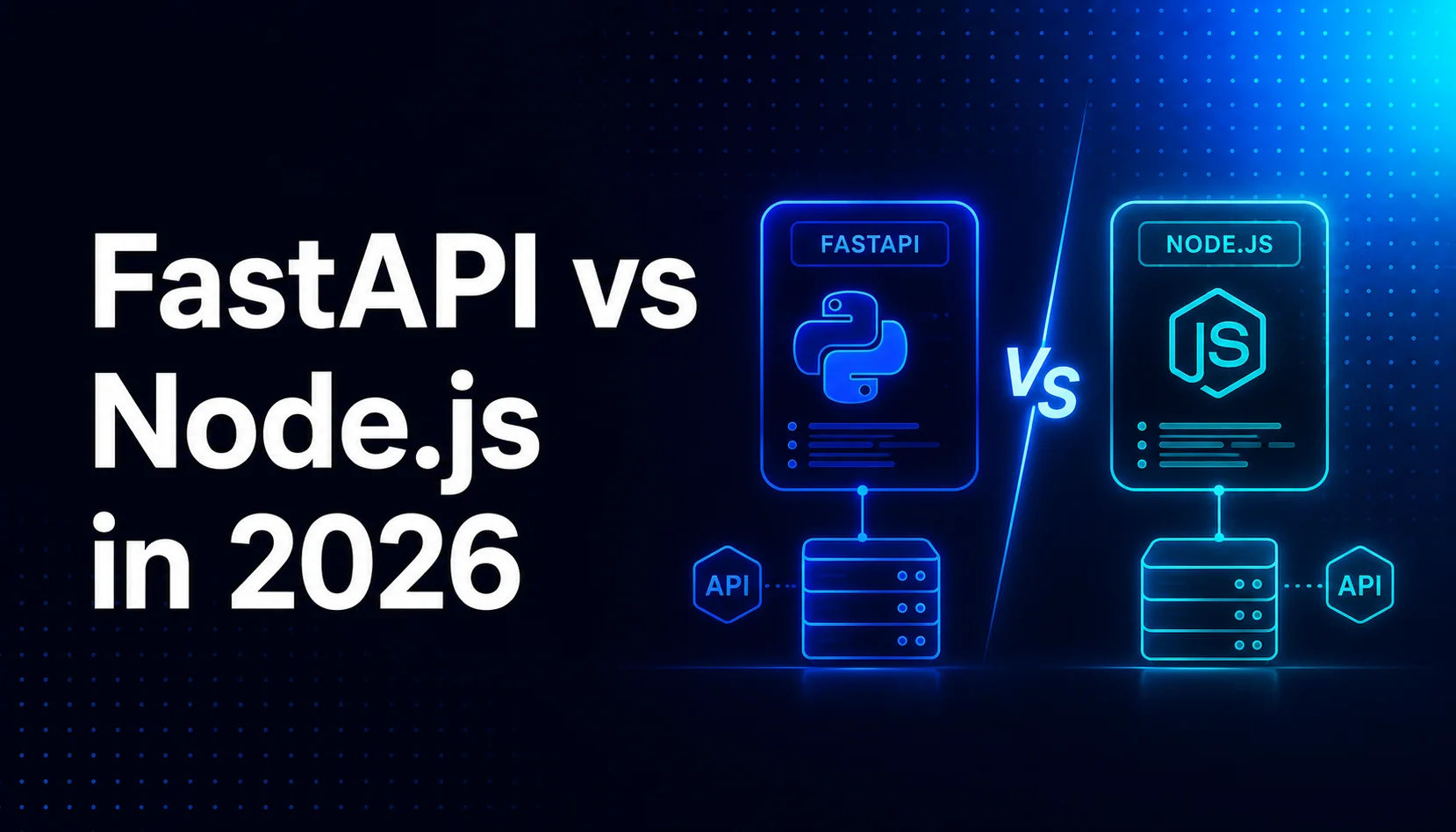
FastAPI or Node.js in 2026? After building production projects with both stacks and helping clients make this exact architectural call - here is my honest, technical breakdown. Not a generic comparison, but the real thought process a full stack developer goes through when choosing a backend for your project.
As a full-stack developer who works with both Python and JavaScript stacks, one question I get asked constantly, by clients, colleagues, and junior developers, is this: "Should I use FastAPI or Node.js for this project?"
It is a fair question, and the honest answer is that both are excellent. Neither is a mistake. But they are good at different things, and picking the one that fits your project (and your team) saves you a lot of friction later. So here is my straight, no-hype comparison of FastAPI and Node.js in 2026, including a quick comparison table, real use cases, and the exact framework I use to decide.
What are we actually comparing?
First, let us be precise, because these two things are not quite the same category.
Node.js is a JavaScript runtime. It lets you run JavaScript on the server, using the same language as the browser. It has been around since 2009, has a massive ecosystem through npm, and is usually paired with a framework like Express, Fastify, or NestJS to build APIs.
FastAPI is a Python web framework. It is built on modern async Python, uses type hints for validation through Pydantic, and generates API documentation automatically. It is younger than Node, but it has become the default choice for Python developers building APIs.
So really we are comparing "JavaScript on the server" with "a modern Python API framework." Keep that in mind, because the right choice often comes down to language and ecosystem more than raw features.
FastAPI vs Node.js at a glance
Factor | Node.js | FastAPI |
|---|---|---|
Language | JavaScript / TypeScript | Python |
Best for | Full-stack JS apps, React/Next.js, real-time | AI/ML, data-heavy APIs, Python teams |
Performance | Excellent for I/O and real-time workloads | Excellent, strong for data validation and CPU-bound tasks |
Data validation | Manual (libraries like Zod) | Built in (Pydantic) |
API documentation | Manual setup | Automatic (OpenAPI / Swagger) |
Real-time (WebSockets) | Strong, mature ecosystem | Possible, less common |
Ecosystem | Huge (npm) | Growing, strongest in data and AI |
Learning curve | Easy if you know JavaScript | Easy if you know Python |
The table gives you the shape of it. Now let me explain the parts that actually matter in practice.
Performance: what the benchmarks actually show
Both are fast enough for the vast majority of applications, so do not choose based on benchmark charts you saw online.
Node.js shines with I/O-heavy and concurrent workloads. Its event-loop model handles thousands of simultaneous connections efficiently, which is why it is a favorite for real-time apps, chat, and streaming.
FastAPI is one of the fastest Python frameworks available, thanks to its async foundation. For CPU-bound or data-heavy tasks, Python itself is slower than JavaScript, but in the real world most of that heavy lifting happens inside optimized libraries (written in C under the hood), so the gap rarely matters.
The honest takeaway: for typical web APIs, both are more than fast enough. Performance is almost never the deciding factor. Your database design and architecture will affect speed far more than the choice of framework.
Developer experience: where they differ most
This is where the two genuinely diverge.
FastAPI gives you a lot for free. You define your data models with Python type hints, and it validates incoming requests automatically through Pydantic. It also generates interactive API documentation (Swagger and OpenAPI) with zero extra work. For an API-first project, that is a real time saver.
With Node.js, validation and documentation are things you set up yourself. You reach for a library like Zod to validate input, and a separate tool to generate docs. It is completely doable and very common, but it is more moving parts than FastAPI's batteries-included approach.
If your project is essentially "a well-documented, well-validated API," FastAPI's developer experience is hard to beat.
The full-stack JavaScript advantage of Node.js
Here is where Node.js pulls ahead for a huge number of projects: one language across the whole stack.
If your frontend is React or Next.js, choosing Node.js on the backend means you write JavaScript (or TypeScript) everywhere. You share types between frontend and backend, reuse validation logic, and your whole team works in one language. For example, when you are building a REST API with the Next.js App Router, you can keep the entire product in a single codebase, which I cover in detail in my guide on [building a REST API with Next.js in 2026](https://osamahabib.com/blog/rest-api-nextjs-app-router-2026).
For most modern web products, especially SaaS built on Next.js, this single-language advantage is the quiet reason Node.js wins.
Where FastAPI genuinely wins
FastAPI is not a runner-up. There are projects where it is clearly the better choice.
1. AI and machine learning integration
If your product touches AI, ML, or data science, Python is the ecosystem. Libraries like PyTorch, scikit-learn, pandas, and the major LLM tooling all live in Python first. FastAPI lets you wrap that power in a clean API without leaving the language.
2. Data validation at scale
Pydantic makes complex, strict data validation feel effortless. If your API handles intricate data structures where correctness is critical, FastAPI's built-in validation is a genuine advantage.
3. Automatic API documentation
For teams that live and die by their API contract, FastAPI's automatic, always-up-to-date documentation removes a whole category of busywork.
4. Rapid prototyping
Because so much comes built in, you can stand up a validated, documented API remarkably fast. For data-focused prototypes, FastAPI is a joy.
My decision framework: how I actually choose
When a client asks me which to use, I do not overthink it. I run through these questions in order, and I usually have my answer within the first two:
Does the project need machine learning or Python-specific libraries? If yes, choose FastAPI.
Is the frontend React or Next.js? If yes, Node.js keeps everything in one language.
Is it a real-time application (chat, live updates, streaming)? Node.js has the more mature ecosystem.
Does it involve complex, strict data validation? FastAPI's Pydantic makes this easier.
Is your team stronger in JavaScript? Choose Node.js. A team's fluency beats any benchmark.
Is your team stronger in Python? Choose FastAPI for the same reason.
Notice that half of these come down to language and team, not the frameworks themselves. That is deliberate, because it is usually the right way to decide.
When I have used both, and why
To make it concrete: for a data-heavy SaaS where the backend design matters as much as the framework, I lean toward the ecosystem that fits the workload best, and I plan the database carefully either way. If you are building something in that category, the data layer is worth as much attention as the language, which is something I break down in my guide on [building multi-tenant SaaS with Next.js, Prisma, and PostgreSQL](https://osamahabib.com/blog/multi-tenant-saas-nextjs-prisma-postgresql).
For a full-stack Next.js product with a React frontend, I reach for Node.js almost every time, because sharing one language across the stack keeps the whole thing simpler and faster to build.
For an AI-powered feature or a data-processing service, FastAPI is my default, because Python is where that ecosystem lives.
FastAPI vs Node.js: final verdict for 2026
There is no universal winner, and anyone who tells you otherwise is selling something. Here is the short version:
Choose Node.js if you are building a full-stack JavaScript product, especially with React or Next.js, need real-time features, or your team is strongest in JavaScript.
Choose FastAPI if your project involves AI or machine learning, needs heavy data validation, is API-first, or your team is strongest in Python.
Both will serve you well for years. The best backend is the one that fits your product and the people building it.
Frequently asked questions
Is FastAPI faster than Node.js?
For most web APIs, both are fast enough that the difference does not matter in practice. Node.js excels at concurrent I/O, while FastAPI is one of the fastest Python frameworks. Your architecture and database design affect real-world speed far more than the framework choice.
Should I use FastAPI or Node.js with a Next.js frontend?
Node.js usually makes more sense with a Next.js frontend, because you can use one language across the whole stack, share types, and keep everything in a single codebase. FastAPI is a better fit when you specifically need Python for AI or data work.
Is FastAPI better than Node.js for AI projects?
Yes, for most AI and machine learning work, FastAPI is the stronger choice because the major AI and data libraries live in the Python ecosystem. FastAPI lets you expose that functionality through a clean, well-documented API.
Which is easier to learn, FastAPI or Node.js?
It depends on your background. FastAPI is easy to pick up if you already know Python, and Node.js is easy if you know JavaScript. Neither is significantly harder than the other, so your existing language is usually the deciding factor.
I help startups and businesses make these exact architectural decisions, and then build the complete solution, from backend API to frontend interface. Whether you need a MERN stack application, a Next.js full-stack platform, or a FastAPI-powered backend, I can help you ship the right product. Tell me what you are building at (https://osamahabib.com/contact) and I will help you choose and build it.
Osama Habib
Multan, Pakistan
Full Stack Developer specialising in Next.js, Node.js, and the MERN stack. I write about modern web development, system design, and practical engineering.